Duende Legend, Origin and Folklore | Tabula Supernaturalis
Duende is catalogued under Fae & Little Folk from Andalusia / Latin America, Spain / Mexico. Read origin, appearance, sightings, cultural cousins, and...
Origin and tradition
Iberian Catholic folklore stating Duendes are the souls of unbaptized children who died, or angels who refused to fight during Lucifer's revolt. This atlas keeps the older tradition separate from later reports: it locates the legend in Andalusia / Latin America, Spain / Mexico, and treats sightings as evidence of transmission rather than proof of a verified creature.
Appearance
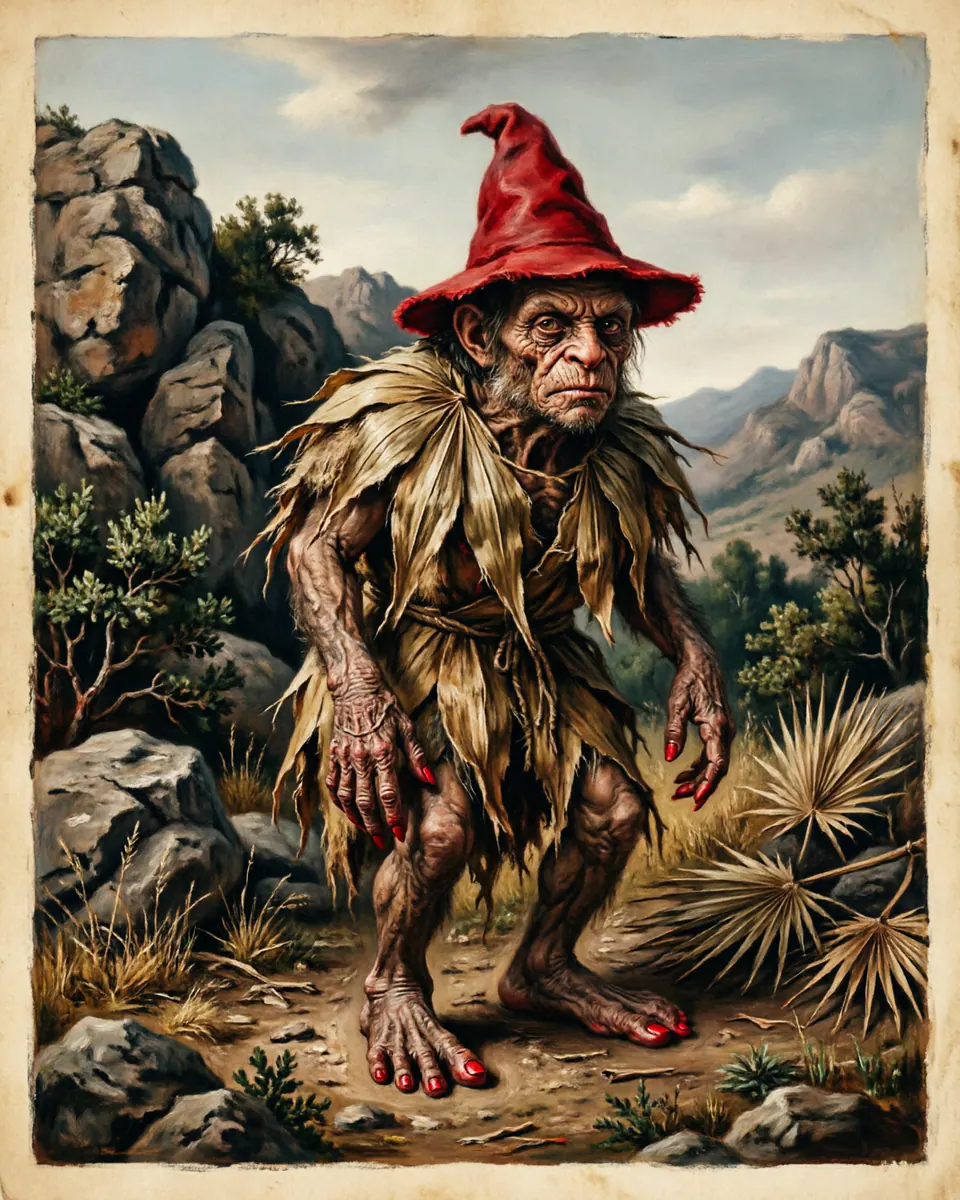
A short, stocky creature wearing a red pointed hat (Chupalla) and garments of dry palm leaves, with long wrinkled fingers and forward-slanted toes. The creature should read as small or uncanny through scale, clothing, tools, footprints, and boundary spaces such as houses, fields, trees, or stones.
Reported abilities
- Hiding Keys & Coins
- Sinking beneath Stone Slats
- Inducing Forest Trances
Field notes
Duendes prefer to reside in the interior walls of houses, tickling people's feet or misplacing keys. They can be expelled by placing a clean plate of salt next to their hole. Little-folk traditions often work like rules for living with a landscape or household, so the atlas emphasizes bargains, offerings, tricks, and respect for boundaries.
Related traditions
The Spanish-speaking world's Leprechaun, matching the Hawaiian Menehune in building tracks and forest prank patterns. The comparison is motif-based rather than a claim of direct borrowing: it links Duende to related beings through trickster rules, miniature scale, domestic or field boundaries, offerings, hidden labor, and the uncertainty between helper and threat, while preserving its local name, place, and cultural function.