Menehune Legend, Origin and Folklore | Tabula Supernaturalis
Menehune is catalogued under Fae & Little Folk from Kaua'i Coastline, USA (Hawaii). Read origin, appearance, sightings, cultural cousins, and source notes.
Origin and tradition
Ancient Polynesian settlers tracked a small-statured race of dwarf deep artisans who lived in Kauai's high volcanic canopies. This atlas keeps the older tradition separate from later reports: it locates the legend in Kaua'i Coastline, USA (Hawaii), and treats sightings as evidence of transmission rather than proof of a verified creature.
Appearance
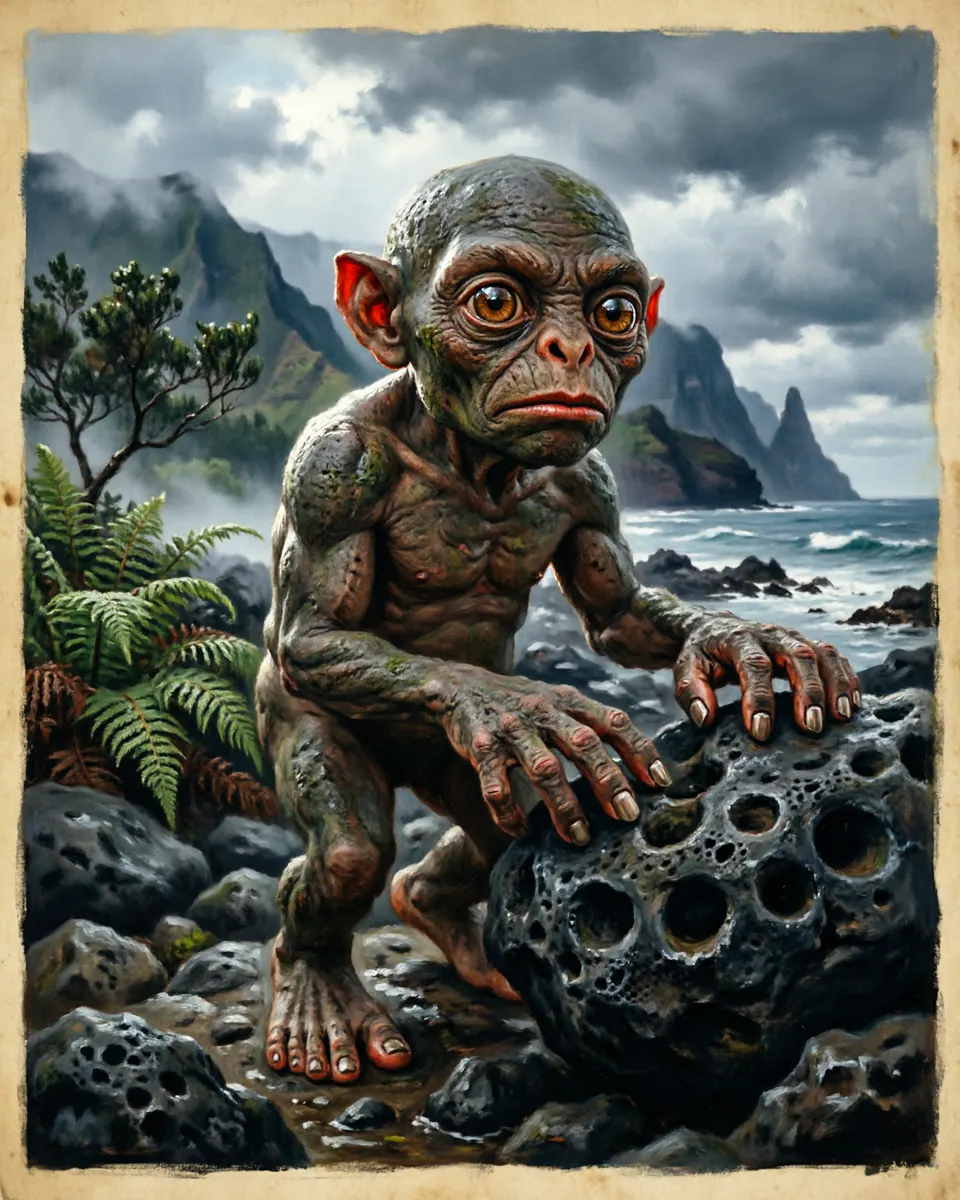
A small, muscular humanoid standing around 2 feet tall, with rugged skin, large brown eyes, and incredibly skilled fingers for rock architecture. The creature should read as small or uncanny through scale, clothing, tools, footprints, and boundary spaces such as houses, fields, trees, or stones.
Reported abilities
- Massive Overnight Construction
- Stone-Carving Mastery
- Invisible Foliage Stealth
Field notes
Legends state they built the Alekoko Fishpond over a single night. They are highly territorial and refuse to work if they are seen by any human eye during construction. Little-folk traditions often work like rules for living with a landscape or household, so the atlas emphasizes bargains, offerings, tricks, and respect for boundaries.
Related traditions
An indigenous architectural little folk class whose overnight construction parallels Spain's Duende. The comparison is motif-based rather than a claim of direct borrowing: it links Menehune to related beings through trickster rules, miniature scale, domestic or field boundaries, offerings, hidden labor, and the uncertainty between helper and threat, while preserving its local name, place, and cultural function.