Yeti (Abominable Snowman) Legend, Origin and Folklore | Tabula Supernaturalis
Yeti (Abominable Snowman) is catalogued under Humanoid Cryptids from Himalayas, Nepal / Tibet. Read origin, appearance, sightings, cultural cousins, and...
Origin and tradition
Sherpa folklore speaks of three types of wild mountain men: the small 'Mitre', the sheep-killing 'Thelma', and the giant 'Chute'. This atlas keeps the older tradition separate from later reports: it locates the legend in Himalayas, Nepal / Tibet, and treats sightings as evidence of transmission rather than proof of a verified creature.
Appearance
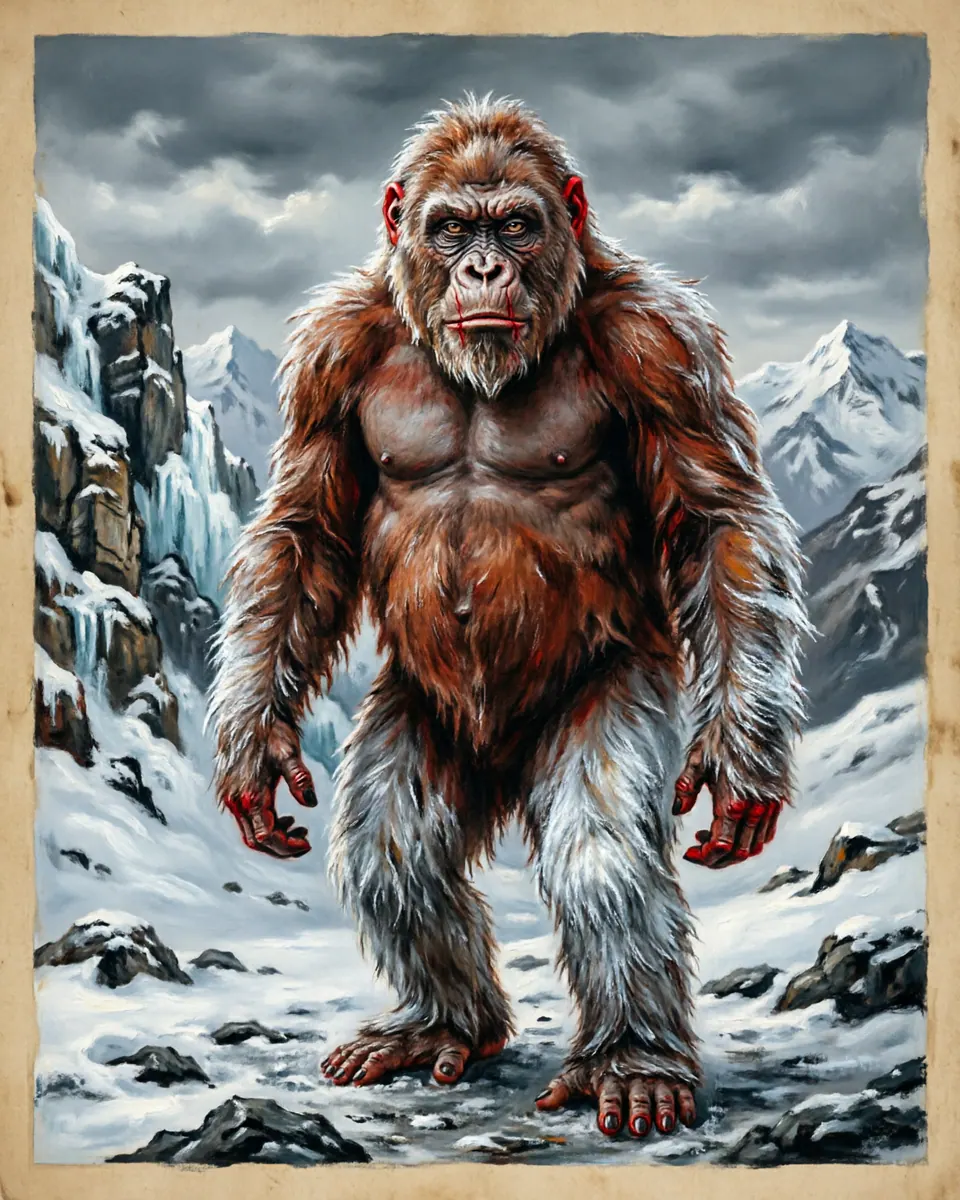
A towering, bipedal ape-man covered in dense, shaggy reddish-brown or silver-white fur, with a conical skull and high-set predatory eyes. The silhouette should stress posture, gait, hair or skin texture, and terrain clues rather than turning the being into a generic human or ape.
Reported abilities
- High-Altitude Oxygen Independence
- Savage Frost Resistance
- Mimicry of Human Cries
Field notes
Sherpas warn that Yeti footprints are often oriented backward to confuse tracking parties. Scalps kept in Himalayan monasteries like Khumjung have been tested as goat/bear hides, but high-altitude tooth records remain anomalous. Humanoid cryptid reports are strongest when the copy separates footprint lore, wilderness fear, and local naming from claims of a confirmed species.
Related traditions
The snow-adapted variant of the global 'Wild Man of the Woods' (Bigfoot in the USA, Almas in Mongolia, and Yowie in Australia). The comparison is motif-based rather than a claim of direct borrowing: it links Yeti (Abominable Snowman) to related beings through wild-person traditions, marginal landscapes, strange tracks, nocturnal calls, and the fear that something near-human lives just outside settlement, while preserving its local name, place, and cultural function.