Werewolf / Lycanthrope Legend, Origin and Folklore | Tabula Supernaturalis
Werewolf / Lycanthrope is catalogued under Shapeshifters & Lycanthropes from Continental Forests, Germany / France. Read origin, appearance, sightings,...
Origin and tradition
Ancient Greco-Roman texts (e.g. King Lycaon of Arcadia) and medieval European trials where men confessed to possessing wolf belts. This atlas keeps the older tradition separate from later reports: it locates the legend in Continental Forests, Germany / France, and treats sightings as evidence of transmission rather than proof of a verified creature.
Appearance
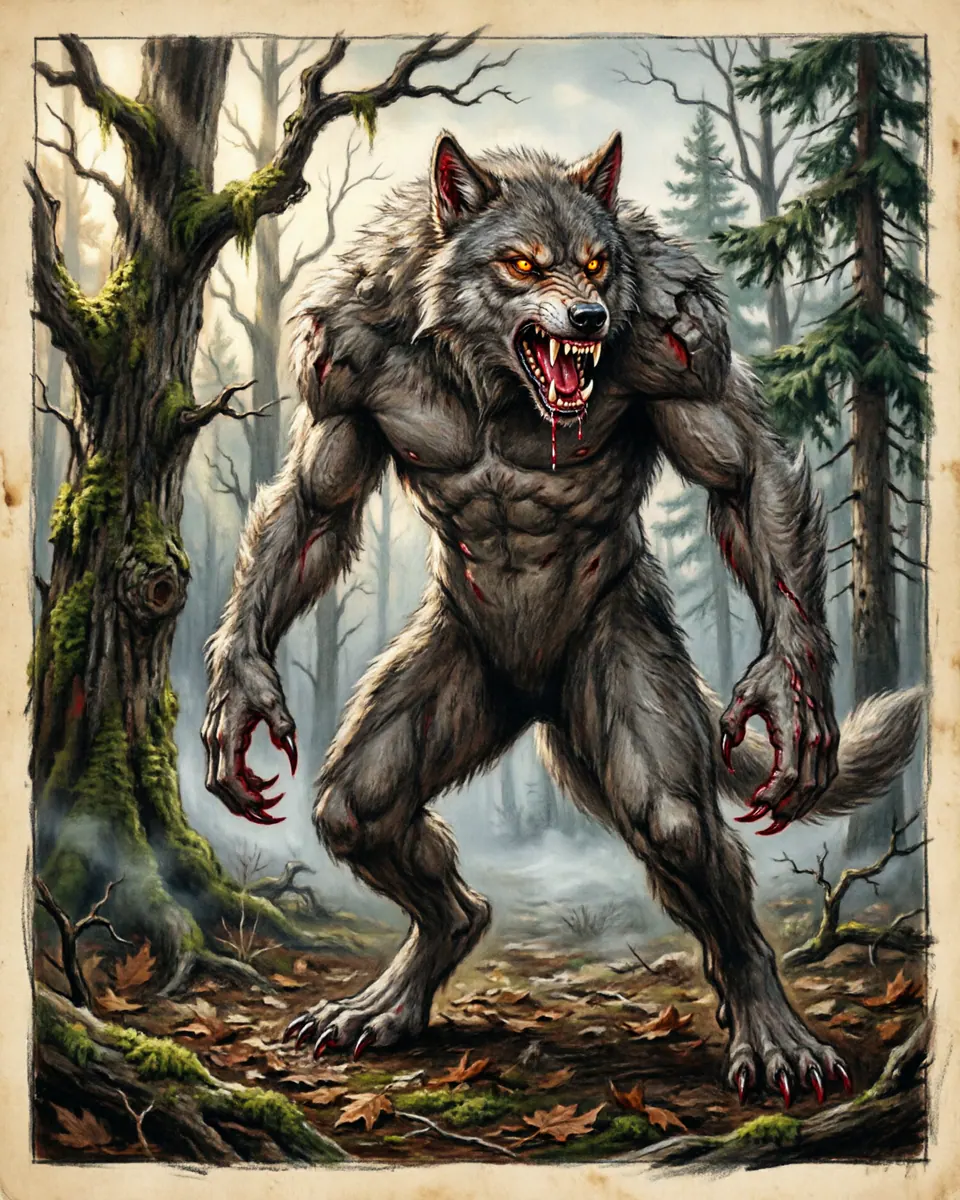
A monstrous hybrid shape of a man and a gray forest wolf, standing with hyper-extended hind claws, glowing amber eyes, and bone-crushing jaws. The design should preserve the transformation clue, showing the boundary between human, animal, and uncanny form rather than settling on one ordinary body.
Reported abilities
- Sliver-Bullet Vulnerability
- Lunamorphic Transformation
- Flesh-Healing Regeneration
Field notes
Historically blamed on ergot poisoning (hallucinogenic wheat mold) or rabies, but the sheer volume of wolf-man trials across old Bavaria indicates deep-seated fear. Shapeshifter entries are read as social warnings as much as monster reports, so the atlas keeps attention on disguise, taboo behavior, and the moment the hidden form breaks through.
Related traditions
The absolute standard of Western shapeshifters, sharing morphic curses with North America's Skinwalker and Mesoamerica's Nagual. The comparison is motif-based rather than a claim of direct borrowing: it links Werewolf / Lycanthrope to related beings through dual identity, forbidden transformation, reversed tracks, animal doubles, and anxieties about neighbors who are not what they appear to be, while preserving its local name, place, and cultural function.