Lindworm Legend, Origin and Folklore | Tabula Supernaturalis
Lindworm is catalogued under Dragons & Sea Serpents from Scandinavia & Germany, Sweden / Germany. Read origin, appearance, sightings, cultural cousins, and...
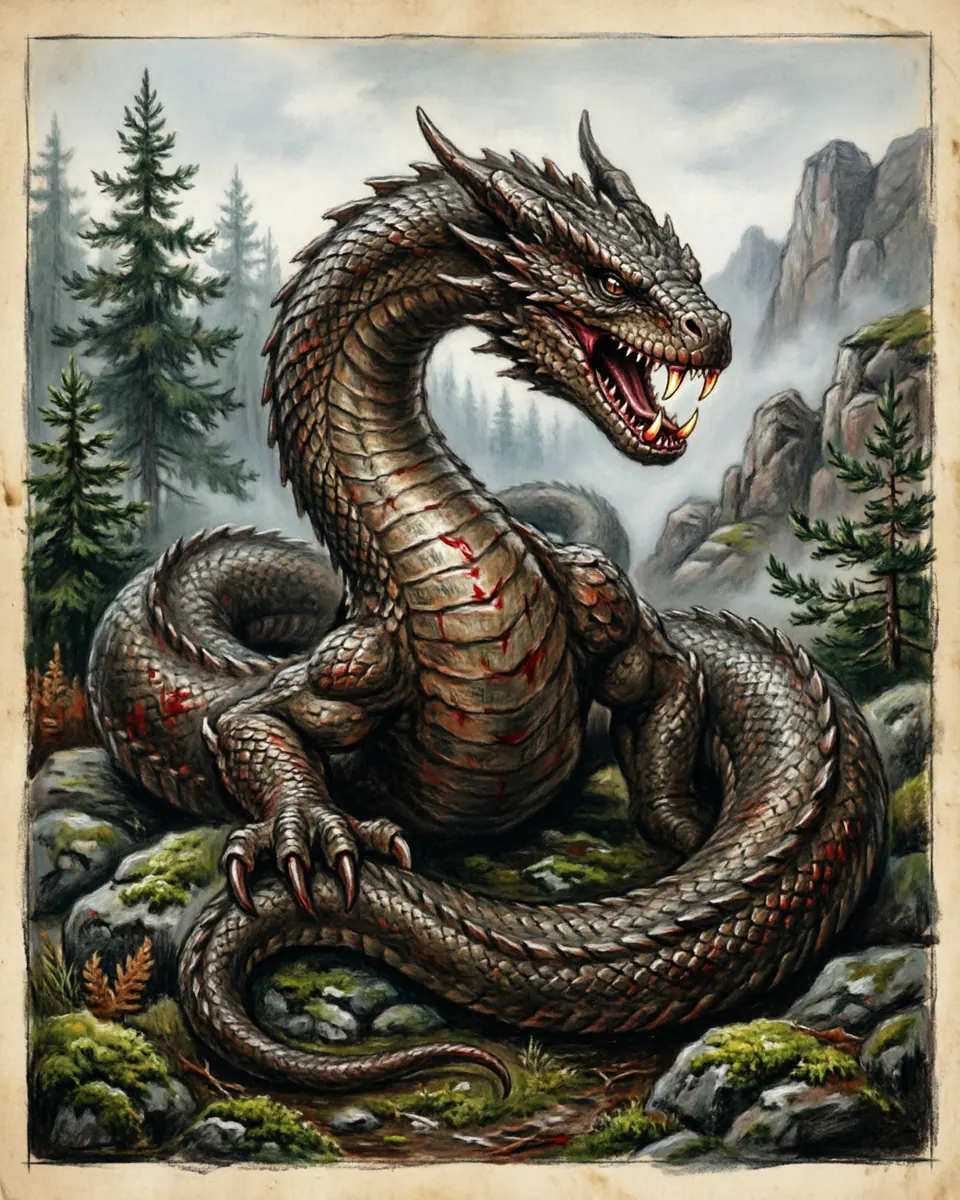
Origin and tradition
Mentioned in old runestones and Germanic sagas like the Nibelungenlied. A young princess bought a small worm that swelled into a giant sheep-eating dragon. This atlas keeps the older tradition separate from later reports: it locates the legend in Scandinavia & Germany, Sweden / Germany, and treats sightings as evidence of transmission rather than proof of a verified creature.
Appearance
A massive, wingless scaly dragon with only two strong front claws, a heavy serpentine tail, and toxic fangs. The body plan should keep the legendary signature clear, whether serpent, bird, hybrid, or scaled guardian, with scale cues that separate it from a normal animal.
Reported abilities
- Corrosive Acid Spray
- Bone-Crushing Coil Constriction
- Burrowing in Sand mounds
Field notes
Ragnar Lodbrok earned his famous pelt trousers by coating them in tar and sand to protect himself from the Lindworm's acidic blood during a rescue trial. Dragon and great-serpent traditions often carry political, elemental, or cosmological meaning, so size, habitat, and symbolic function matter as much as anatomy.
Related traditions
A transitional step between standard water snakes and Western winged Dragons like Wyverns. The comparison is motif-based rather than a claim of direct borrowing: it links Lindworm to related beings through colossal scale, elemental force, guarded treasure or thresholds, serpent motion, wings or horns, and the old idea that landscape itself can become animate, while preserving its local name, place, and cultural function.