The Kraken Legend, Origin and Folklore | Tabula Supernaturalis
The Kraken is catalogued under Lake & Sea Monsters from Norwegian & Greenland Seas, Norway. Read origin, appearance, sightings, cultural cousins, and source...
Origin and tradition
Mentioned first in detailed writing by King Sverre of Norway in 1180. Later codified by Bishop Pontoppidan in 1752 as a beast the size of a floating island. This atlas keeps the older tradition separate from later reports: it locates the legend in Norwegian & Greenland Seas, Norway, and treats sightings as evidence of transmission rather than proof of a verified creature.
Appearance
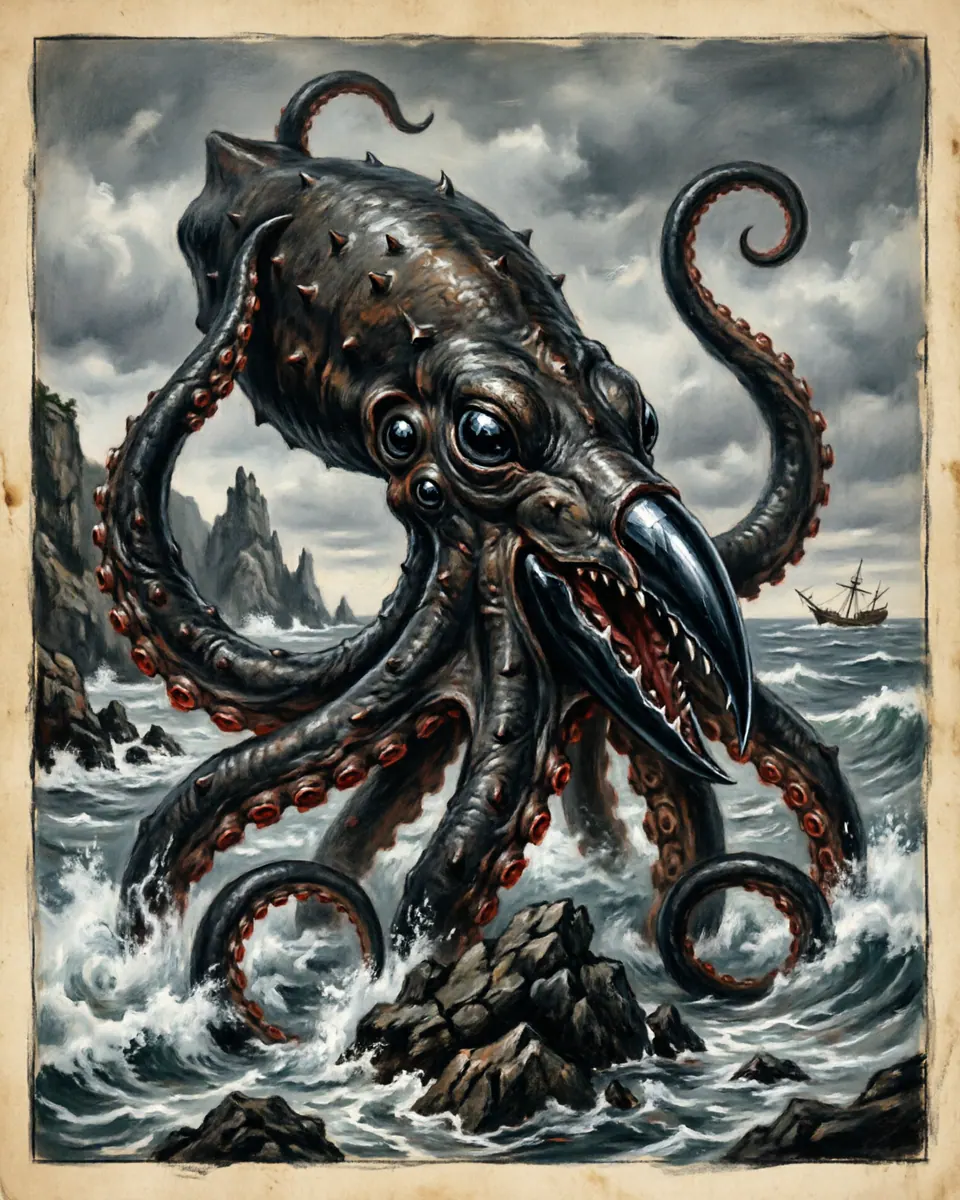
A colossal cephalopod entity with immense spiked tentacles capable of crushing heavy galleons, black multi-faceted eyes, and a beak of hardened obsidian. The most important visual clue is how the body breaks the water: scale, shoreline context, and wet hide should stay readable so the legend does not collapse into a generic reptile or fish.
Reported abilities
- Whirlpool Creation (Maelstrom)
- Blinding Acidic Ink Cloud
- Vessel-Sinking Constriction
Field notes
Sailor accounts often describe the Kraken as island-sized, drawing fish upward before pulling vessels toward the cold depths. Modern knowledge of giant squids gives the legend a plausible animal backdrop, but the mythic Kraken remains much larger and more symbolic than any confirmed cephalopod. Because water legends often mix animal misidentification, hazard warnings, and sacred-place etiquette, the atlas treats recurring geography and behavior as more important than a single fixed anatomy.
Related traditions
Corresponds directly with Japan's Umibōzu (colossal ocean shadows) and ocean-swallowing serpents of Norse mythology like Jörmungandr. The comparison is motif-based rather than a claim of direct borrowing: it links The Kraken to related beings through water danger, hidden depth, shoreline taboo, and the way witnesses describe scale through waves, boats, or river crossings, while preserving its local name, place, and cultural function.