Chinese Dragon (Long) Legend, Origin and Folklore | Tabula Supernaturalis
Chinese Dragon (Long) is catalogued under Dragons & Sea Serpents from Yellow River Valley, China. Read origin, appearance, sightings, cultural cousins, and...
Origin and tradition
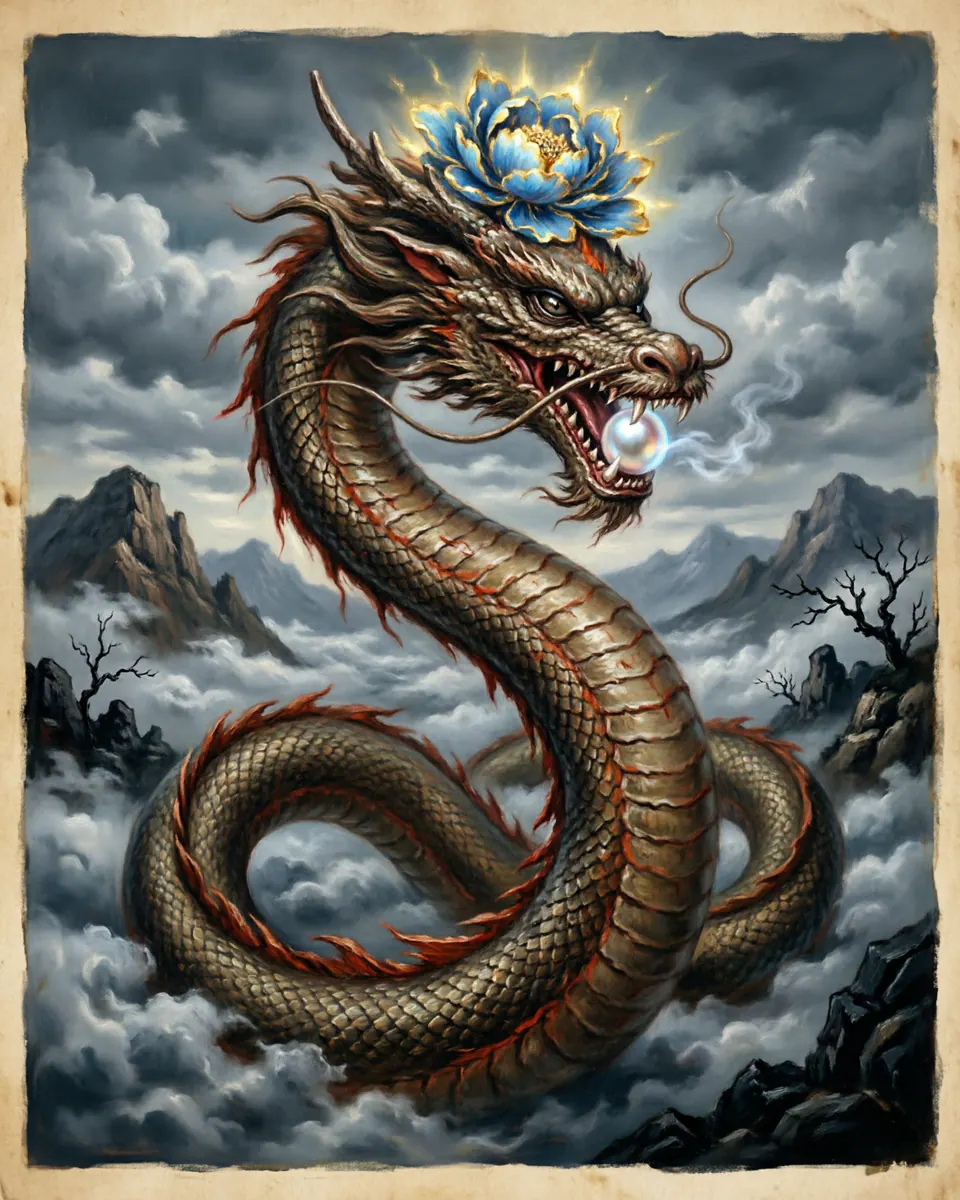
Recorded on Neolothic jade carvings (e.g. Hongshan Culture in 4000 BC) as a protective amalgam of deer antlers, camel head, tiger paws, eagle claws, and fish scales. This atlas keeps the older tradition separate from later reports: it locates the legend in Yellow River Valley, China, and treats sightings as evidence of transmission rather than proof of a verified creature.
Appearance
A long, wingless serpentine dragon that flies through the clouds via its spiritual 'Mudan' crown, glowing blue-gold with an optional pearl in its jaw. The body plan should keep the legendary signature clear, whether serpent, bird, hybrid, or scaled guardian, with scale cues that separate it from a normal animal.
Reported abilities
- Absolute Weather Calling
- Spatial Invisibility
- Tidal Control via Dragons Pearls
Field notes
Unlike Western dragons, the Chinese Long represents rain, peace, and imperial authority. Emperors claimed their bloodline descended directly from these grand sky-snakes. Dragon and great-serpent traditions often carry political, elemental, or cosmological meaning, so size, habitat, and symbolic function matter as much as anatomy.
Related traditions
The sovereign of Asian sky dragons, directly mirroring the divine meteorological function of Mexico's Quetzalcoatl. The comparison is motif-based rather than a claim of direct borrowing: it links Chinese Dragon (Long) to related beings through colossal scale, elemental force, guarded treasure or thresholds, serpent motion, wings or horns, and the old idea that landscape itself can become animate, while preserving its local name, place, and cultural function.